From Parlour to Public Room: How Shared Arts Spaces Took Shape
Shared arts spaces changed as rooms opened beyond private circles. See how purpose, access and the meaning of gathering shaped creative life.
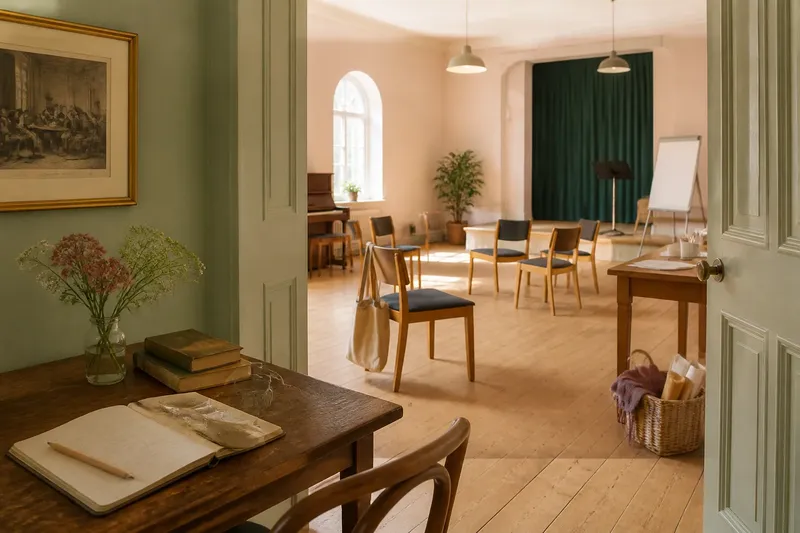
How did shared arts spaces move from the parlour into public life? The shift was not a single historical handover: the domestic parlour and civic meeting room served different purposes and could coexist. A parlour hosted invited company; a library room, club or hall could bring together people beyond one household, though its rules still shaped who felt welcome.
The parlour’s circle
A parlour was a domestic space arranged for receiving visitors. In households that had one, it might host conversation, music, reading aloud, drawing or small performances. These pastimes were shared, but the circle depended on invitation, household custom and social ties.
Chairs could be drawn together for conversation or turned towards someone playing an instrument. A table might hold writing materials or a game. Culture was part of sociability rather than separated from daily life by a dedicated venue.
That did not make parlour culture open to everyone. Access depended on being welcomed into a particular home, and domestic space carried the host’s expectations. The same room could encourage informal exchange while reflecting distinctions of class, gender and status. It was shared within a circle, not necessarily with the surrounding community.
Civic rooms and access
There is no single date when cultural activity moved from homes into public rooms. Domestic gatherings continued as libraries, reading rooms, clubs and halls provided other settings for meeting. These institutions had varied purposes and admission arrangements; a library’s reading room, for example, was not the same kind of space as a club or a hired hall.
Such rooms make the change easier to picture without treating it as a universal historical sequence. A library could offer a place to read outside the home; a local hall could host a meeting or performance; a club might organise activity for its members. Each created possibilities beyond a household, but each also set conditions for entry and use.
Opening a door did not, by itself, make a place equally accessible. Membership rules, fees, opening hours or unfamiliar conventions could leave newcomers uncertain. A room might be formally available yet feel difficult to enter if visitors did not know how to join in. The change was not simply from private to public; it involved decisions about who counted as part of the public.
In a parlour, the host’s invitation often settled who could attend. In a shared room, that decision could sit with an organisation, a committee, a library policy or a local group. Authority moved from one household to an institution or collective, bringing new possibilities and new boundaries.
Different rooms, different roles
Not every shared arts space asks people to do the same thing. Some are arranged mainly for watching or listening. Others support practice, discussion or teaching. A hall might host a rehearsal one evening and a performance another; a library room might shift from quiet reading to a group discussion.
This difference matters because a space’s purpose shapes its social relationships. An audience-facing room gives attention to performers and invites people to experience work together. A participatory room gives visitors a chance to contribute, perhaps by reading a poem aloud or joining a conversation. Neither role is automatically more valuable; they meet different needs.
Think of a room as a dining table. The same table can support a meal, a shared project or a formal meeting, but its arrangement and the people who set its rules change what feels possible. In a public room, chairs, equipment, lighting and the welcome at the door likewise signal how people are expected to take part.
Who shapes the welcome
Shared space involves more than a building. Someone decides what can happen there, when it is open, how the room is arranged and how people learn about activities. Those decisions may sit with a council, charity, venue manager, volunteer group or the people who use the space. The arrangement affects whether a room feels like a service offered to visitors or a place they help shape.
Say a neighbourhood group is offered a room usually used for formal talks. They want to hold an informal poetry gathering. If the chairs stay in rows and nobody explains that visitors may read, the event may feel like a performance. If the group can rearrange the chairs and make the invitation clear, people may find it easier to contribute. The room has not changed ownership, but its use has become more negotiable.
That negotiation can be delicate. A venue needs to look after its space and meet its responsibilities, while users may want freedom to adapt it. Clear expectations can help people feel at ease. The useful question is whether the rules support the activity and make sense to the people arriving.
Reading a room’s publicness
Publicness is not a simple label. A room may be publicly owned but rarely used for culture, or run by a local organisation while serving a broad community. In practice, consider how people hear about it, whether they can enter without already knowing someone and whether the activity allows different ways to take part.
That distinction helps explain why shared arts spaces are not a straightforward story of ever-widening access. Some rooms opened opportunities; others retained selective customs or developed new barriers. People have also made cultural life in ordinary spaces: a borrowed room, neighbourhood hall or library corner can become a gathering place when people return and give it a shared purpose.
Questions about shared rooms?
What counts as a shared arts space?
It is a place where people gather around cultural activity, whether to make, discuss, teach, perform or experience creative work. The term describes a social use of a room, not one particular building type.
How does it differ from a private arts gathering?
A private gathering depends on invitation into a home or closed circle. A shared setting is organised to admit a broader group, although local rules and practical barriers can still shape who feels able to attend.
Must a public room host performances?
No. A reading group, discussion, rehearsal or informal creative gathering can give a room a cultural purpose. Participation can involve listening and exchanging ideas as well as making or presenting work.
Who decides how a community room is used?
That depends on the venue: decisions may be made by a local authority, organisation, manager or group of users. Asking who controls bookings and whether users can influence the arrangement gives a clearer picture than the room’s name alone.
Purpose makes the room
The movement from parlour to public room is best understood as a change in relationships, not a clean break between two eras. Domestic rooms made shared culture possible within invited circles; civic and community rooms offered other settings beyond the household. Their meaning comes from the people who open them, the people who enter and the customs that determine how they meet.
When you encounter shared arts spaces, notice what the room invites you to do. A stage, a ring of chairs or a table set for conversation each suggests a different kind of participation. Asking who sets the room’s rules—and whether users can shape them—often reveals more than the building’s name.